Mapping the Resistance Landscape: A Practical Guide to Chloroquine-Resistant Malaria for US Travelers and Clinicians
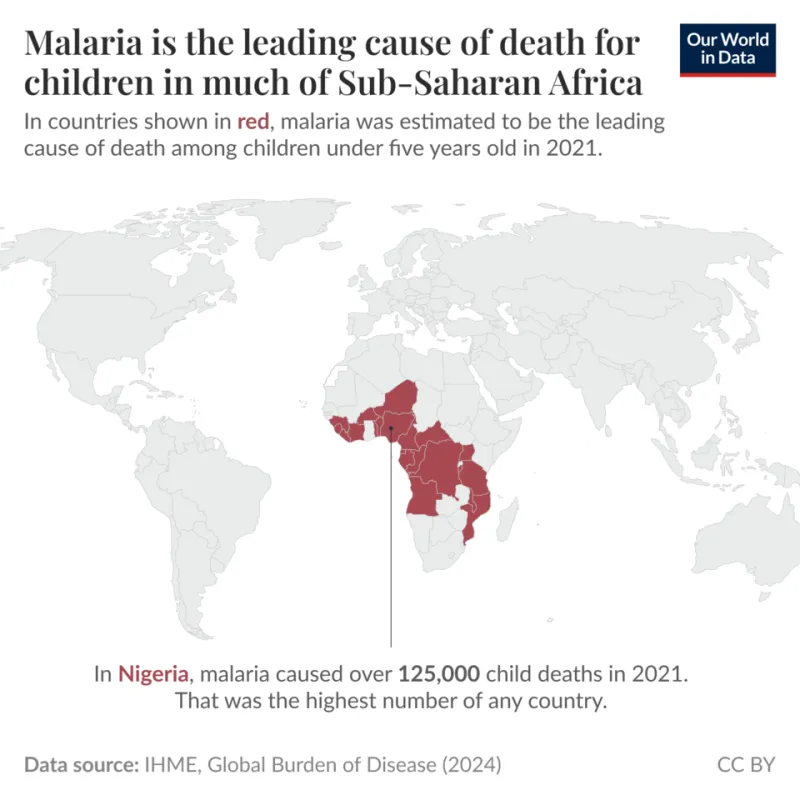
Photo: Our World in Data, CC BY 4.0, via Wikimedia Commons
For much of the twentieth century, chloroquine stood as the unchallenged cornerstone of malaria prevention and treatment. Inexpensive, well-tolerated, and remarkably effective, it protected millions of travelers and residents in endemic regions alike. Then, beginning in the late 1950s and accelerating through subsequent decades, something changed: Plasmodium falciparum—the most lethal of the malaria-causing parasites—began to outwit the drug. Today, chloroquine resistance is not an emerging concern. It is an established global reality that clinicians and travelers must understand in granular, geographic detail.
How Resistance Develops: A Brief Primer
Chloroquine exerts its antimalarial effect primarily by interfering with the parasite's ability to detoxify heme within red blood cells, leading to toxic accumulation that kills the organism. Resistance arises when mutations in the pfcrt gene—and, secondarily, the pfmdr1 gene—alter the parasite's digestive vacuole, effectively pumping chloroquine away from its site of action before it can do damage.
What makes this resistance particularly consequential is its durability. Once established in a parasite population, these genetic mutations persist and spread. Decades of widespread chloroquine use created powerful selective pressure, and the drug's long half-life—while therapeutically advantageous in other contexts—paradoxically facilitated the selection of resistant strains by exposing parasites to sub-therapeutic concentrations during the drug's slow elimination.
The Global Resistance Map: Where Risk Is Highest
For American clinicians counseling patients before international travel, the geographic distribution of resistance is the single most important variable in chemoprophylaxis decision-making.
Sub-Saharan Africa carries the heaviest burden. Resistance to chloroquine among P. falciparum is now essentially ubiquitous across most of the continent, including high-traffic destinations such as Kenya, Tanzania, Ghana, and Nigeria. The CDC's current guidelines explicitly advise against chloroquine as a prophylactic agent for travel to these regions, recommending atovaquone-proguanil, doxycycline, or mefloquine instead.
South and Southeast Asia present a complex picture. India, Thailand, Cambodia, Vietnam, and Myanmar harbor not only chloroquine-resistant P. falciparum but also, increasingly, multidrug-resistant strains. The Greater Mekong Subregion has become a focal point of international concern, with artemisinin partial resistance emerging alongside existing chloroquine resistance—a combination that narrows treatment options significantly.
South America and the Caribbean offer a more nuanced situation. In parts of the Amazon Basin—including regions of Brazil, Peru, Colombia, and Venezuela—P. falciparum resistance is well documented. However, Plasmodium vivax, which causes a distinct and often relapsing form of malaria, remains broadly susceptible to chloroquine across most of Latin America. Haiti and the Dominican Republic are notable exceptions to the regional resistance pattern; chloroquine retains efficacy against P. falciparum in these Caribbean nations, making it an appropriate prophylactic choice for travelers to those specific destinations.
The Middle East and Central Asia generally present lower resistance burdens, though clinicians should consult up-to-date CDC and WHO resources before counseling patients, as the situation in conflict-affected areas can shift with population displacement.
Implications for US Travelers, Military Personnel, and Aid Workers
Approximately 2,000 cases of malaria are diagnosed in the United States each year, the overwhelming majority in travelers returning from endemic regions. Military personnel deployed to sub-Saharan Africa or Southeast Asia face occupational exposure that demands rigorous chemoprophylaxis protocols. Similarly, the growing community of American global health workers and humanitarian aid volunteers—often stationed in resource-limited settings for extended periods—requires individualized, evidence-based guidance.
For this population, the practical message is straightforward: destination determines drug choice. A traveler heading to rural Ghana requires a fundamentally different prophylactic regimen than one visiting rural Mexico or the Dominican Republic. Clinicians who prescribe chloroquine for malaria prophylaxis without first verifying the resistance profile of the specific destination risk patient harm through false reassurance.
Primary care providers and travel medicine specialists should also counsel patients on the importance of adherence. Even agents effective against resistant strains provide no protection when doses are missed or discontinued prematurely after return.
Where Chloroquine Remains Clinically Relevant
The prevalence of resistance does not render chloroquine obsolete in the infectious disease setting. Several important niches remain.
First, P. vivax malaria—responsible for a substantial proportion of cases in Central America, parts of South America, and South Asia—remains largely chloroquine-susceptible in most regions, with the exception of parts of Indonesia and Papua New Guinea where P. vivax resistance has been documented. For travelers to chloroquine-sensitive P. vivax zones, the drug retains a legitimate prophylactic role.
Second, chloroquine continues to serve as a treatment option in areas and for parasite species where susceptibility is confirmed. Its favorable safety profile, low cost, and decades of clinical experience make it a preferred agent when resistance data supports its use.
Third, combination strategies and newer formulations continue to be explored in research settings, with some evidence suggesting that pairing chloroquine with resistance-reversing agents could partially restore efficacy against resistant strains—though this approach remains investigational.
Updating Clinical Practice: Recommendations for Prescribers
Several practical steps can improve prescribing accuracy and patient outcomes:
- Consult current CDC Yellow Book guidance before counseling any patient traveling to a malaria-endemic region. Resistance patterns shift, and static knowledge quickly becomes outdated.
- Obtain a detailed itinerary, including rural versus urban destinations, planned activities, and duration of stay. Risk is not uniform within countries.
- Screen for contraindications to alternative agents. Patients with glucose-6-phosphate dehydrogenase (G6PD) deficiency, psychiatric histories, or certain cardiac conditions may have limited prophylactic options, necessitating careful individualization.
- Document the rationale when prescribing chloroquine in any malaria context, particularly if deviating from standard resistance-based guidance.
- Provide standby emergency treatment education for patients traveling to remote areas where medical care is inaccessible.
The Resistance Challenge in Broader Context
Chloroquine resistance is, at its core, a story about the consequences of widespread antimicrobial use without coordinated stewardship. The same biological pressures that eroded chloroquine's efficacy against P. falciparum are now being applied to artemisinin-based therapies—the current first-line treatments for falciparum malaria. This trajectory underscores the urgency of global malaria surveillance, the development of novel therapeutic agents, and the preservation of existing drug efficacy through rational prescribing.
For US clinicians, the immediate obligation is practical: ensure that every patient departing for a malaria-endemic region departs with the right drug for the right destination. Chloroquine remains a valuable tool in the antimalarial arsenal—but only when deployed with a clear-eyed understanding of where it works and where it does not.